Agentic AI in cybersecurity means AI systems that pursue goals on their own, run multi-step tasks and act across connected tools without a human starting each step. In a security operations center, the post says an agent can take an alert, enrich it, assess severity, take a first containment action and write an investigation report. Humans stay in the loop for consequential decisions.
SERIES: Agentic AI in the Enterprise | Part 1 of 2
In 2025, the average time between an attacker’s initial access and full lateral movement through a network (known as breakout time) compressed to just 4 minutes in the fastest observed incidents. The average SOC analyst, working through a queue of hundreds of daily alerts, cannot triage, investigate, and respond in 4 minutes. The math has been broken for years. Agentic AI is the first technology that changes it.
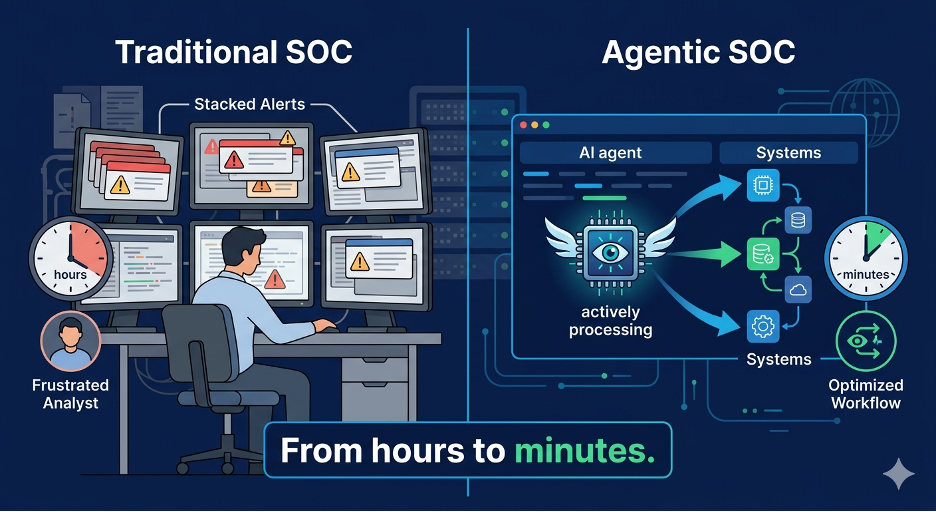
Agentic AI refers to AI systems that do not merely respond to queries; they pursue goals autonomously, execute multi-step tasks, reason through incomplete information, and take actions across integrated tools without requiring a human to initiate each step. In security operations, this means an agent that can receive an alert, correlate it against threat intelligence, query endpoint telemetry, check identity logs, assess severity, execute an initial containment action, and produce a full investigation report, all within seconds, around the clock, without analyst fatigue.
This is not a future capability. It is a present deployment reality. Global infrastructure operators, financial institutions, and government agencies are running agentic AI in their SOCs today, and the performance metrics they are reporting represent a fundamental shift in what security operations can achieve.
This blog explains what agentic AI is and how it differs from previous automation, what it actually does in a SOC context, real-world deployments and their measured outcomes, and what security leaders need to understand before adopting it.
| 4 min average attacker breakout time in 2025; defense must now operate at machine speed | $146.5B projected global AI-in-cybersecurity spend by 2034, up from $24.8B in 2024 | 80% reduction in incident recovery time (MTTR) reported by early agentic SOC adopters | 4M unfilled cybersecurity positions globally; the analyst shortage agentic AI must bridge |
What Is Agentic AI: How Is It Different from What Came Before?
The term ‘AI in cybersecurity’ has been used to describe everything from basic rule-based automation to machine learning classifiers to today’s large language model-powered agents. Understanding what specifically makes agentic AI different is essential for evaluating its potential, and its limitations.
| Rule-Based Automation | Traditional AI / ML | Agentic AI | |
| What it does | Executes fixed if-then playbooks | Classifies, detects anomalies, scores | Reasons, plans, and executes multi-step tasks autonomously |
| Handles novel situations | No: breaks outside defined rules | Partially: limited to trained patterns | Yes: reasons through new scenarios contextually |
| Tool use | Pre-configured integrations only | Limited | Orchestrates multiple tools dynamically |
| Human interaction | Triggers pre-written actions | Alerts for human review | Works alongside humans; escalates when needed |
| Learns from context | No | Batch retraining required | Continuously incorporates context within sessions |
| SOC application | SOAR playbooks, auto-close tickets | Alert scoring, anomaly detection | Full investigation lifecycle, from triage to response report |
💡 The Key Distinction: Goals vs. Instructions Traditional automation executes instructions: ‘if alert type = phishing, run playbook X.’ Agentic AI pursues goals: ‘investigate this alert and determine whether it represents a genuine threat.’ The difference sounds subtle but is operationally transformative. A goal-driven agent can navigate an alert type it has never seen before, query the tools it needs dynamically, reason about ambiguous evidence, and produce a contextually grounded recommendation; tasks that rule-based systems fundamentally cannot perform.
What Does Agentic AI Actually Do in a Security Operations Center?
The SOC workflow maps directly onto the multi-step, tool-intensive, context-dependent tasks that agentic AI is architecturally suited to perform. The following capabilities represent where production deployments are delivering measurable outcomes in 2025.
1. How Does Agentic AI Triage and Enrich Alerts?
The single most acute operational challenge in modern SOC environments is alert volume. Most large enterprise SOCs generate thousands of alerts per day; the practical reality is that analysts triage a small fraction of them. In one documented case, a global infrastructure organization’s analysts were processing only 8% of generated alerts; the remaining 92% were effectively invisible.
Agentic AI addresses this directly. A triage agent receives every alert, automatically enriches it with contextual data: querying threat intelligence feeds for indicator of compromise matches, pulling endpoint telemetry, correlating identity logs, and checking recent activity from the involved IP addresses and accounts; it then produces a severity assessment and initial investigation summary. Human analysts review the agent’s findings and conclusions rather than raw alerts. The agent provides 100% coverage; the analyst provides judgment on the cases that matter.
2. How Does Agentic AI Investigate an Alert?
For alerts that the triage agent flags as requiring investigation, an investigation agent takes over. Rather than presenting the analyst with a queue of raw log entries and asking them to build a picture, the investigation agent autonomously gathers evidence across multiple data sources, correlates it against known attack patterns and the MITRE ATT&CK framework, constructs a timeline of the incident, and generates a structured investigation report with its reasoning documented.
This transforms the analyst’s role from data gatherer to decision maker. The cognitive load of ‘what happened?’ is handled by the agent. The analyst’s expertise is applied to ‘what do we do about it?’: the part of the workflow where human judgment, organizational context, and accountability genuinely matter.
3. Can Agentic AI Contain a Threat on Its Own?
When a threat is confirmed, the window between detection and containment is the most critical variable in limiting damage. Traditional SOC workflows that require human approval for every containment action introduce delays measured in minutes, long enough for lateral movement to occur at machine speed.
Agentic AI can execute pre-authorized containment actions autonomously within seconds of threat confirmation: isolating a compromised endpoint, blocking a malicious IP address at the firewall, revoking an account’s active sessions, or quarantining a suspicious file. The action boundary (what the agent can do autonomously versus what requires human approval) is defined by organizational policy. But within that boundary, the agent acts at the speed the threat requires.
4. How Does Agentic AI Change Threat Hunting?
Traditional SOC operations are overwhelmingly reactive: respond to alerts, investigate incidents, and remediate confirmed threats. Threat hunting, the proactive search for adversary presence that has not yet triggered an alert, is the work that most SOC teams never have time to do because reactive work consumes all available capacity.
Agentic AI changes this capacity equation. When triage and investigation workloads are substantially automated, analyst time is freed for hunting. More directly, a threat hunting agent can autonomously execute hunting hypotheses: ‘are there any processes in this environment exhibiting behaviors consistent with Cobalt Strike staging?’, querying endpoint telemetry at scale, correlating against known indicators, and surfacing candidate findings for analyst review. The agent does the data work; the analyst exercises the hypothesis.
5. AI-Driven Threat Intelligence: From Collection to Action
Threat intelligence in most organizations exists as a collection problem: there is more intelligence available than teams have capacity to process, correlate, and act on. An intelligence agent can continuously monitor threat feeds, dark web sources, vulnerability disclosures, and adversary communication channels, extracting relevant signals, correlating them against the organization’s specific environment and vendor ecosystem, and surfacing actionable intelligence rather than raw data.
This is particularly impactful for time-sensitive intelligence: when a new vulnerability is disclosed and actively exploited, an intelligence agent can immediately check whether any of the organization’s assets or vendors are affected, assess the exposure, and generate a prioritized remediation brief, without waiting for a human analyst to complete the same workflow hours or days later.
⚙️ The Multi-Agent Architecture Production agentic SOC deployments do not rely on a single monolithic agent. They distribute functions across specialized agents (a triage agent, an investigation agent, a threat hunting agent, and an intelligence agent) that collaborate through defined interfaces, passing context and findings between themselves. IBM’s ATOM platform, for example, distributes incident response across agents for investigation, threat hunting, identity management, and vulnerability analysis. This modular architecture is more resilient, more auditable, and more aligned with the specialized expertise model of a human SOC team.
Real-World Deployments: What Agentic AI Is Delivering in Production
Beyond theoretical capability, agentic AI has been in production deployment in security operations since 2024 and 2025. The following cases represent documented outcomes from real organizations.
Transurban: From 8% Alert Coverage to 100%
Transurban, a global roadway operator, faced a SOC coverage crisis: alert volumes had grown to the point where analysts were actively triaging only 8% of generated tickets. The remaining 92% of alerts were effectively unexamined. Hiring additional analysts was not economically viable; the cost and difficulty of recruiting and retaining qualified security professionals made it an unsustainable solution to a structural problem.
The security team built an agentic AI system in-house, deploying two specialized agents: one for categorizing incidents and ensuring correct ticket field completion, and one for verifying resolution notes before ticket closure. Both agents operated within a human-in-the-loop model; they did not close tickets autonomously, but submitted findings and recommendations back to analysts who made the final decision.
The result: 100% coverage of all generated alerts, with a false-positive rate below 3%. Senior analysts who previously spent significant time reviewing inaccurate manual entries were freed to focus on genuine investigation work. The organization is now extending the system to integrate external threat intelligence and add automated triage and containment capabilities.
| 8% alert coverage before agentic AI deployment | 100% alert coverage after deployment, with <3% false positive rate | 0 additional security analyst hires required to achieve this coverage improvement |
The Agentic SOC Metrics Landscape: What Production Numbers Show
Across documented agentic SOC deployments in 2025, a consistent pattern of performance improvement emerges:
| 50% | Reduction in SOC Operational Workload Organizations deploying agentic AI for triage, enrichment, and investigation automation consistently report 40-50% reductions in the analyst time required to process the same alert volume, freeing capacity for higher-value work without increasing headcount. |
| 80% | Reduction in Mean Time to Respond (MTTR) The combination of faster triage, automated investigation, and pre-authorized containment actions compresses response timelines dramatically. Organizations reporting 80% MTTR reduction are achieving containment in minutes rather than hours for the majority of incidents. |
| 60% | Faster Threat Hunting Cycles When routine alert processing is automated, analysts have capacity for proactive hunting, and when AI agents execute hunting hypotheses at scale; the cycle time from hypothesis to finding compresses significantly. 60% faster hunting cycles translate directly to earlier detection of adversary presence. |
| 4 min | Breakout Time vs. Response Benchmark Attackers achieved 4-minute breakout times in 2025’s fastest observed incidents. This is the benchmark that agentic AI must meet: autonomous triage, investigation, and containment that completes before lateral movement begins. For confirmed high-severity incidents, agentic containment can act within seconds; the only technically viable response to machine-speed attack. |
What Agentic AI Is Not: The Governance Reality
The performance numbers are compelling. But responsible adoption of agentic AI in security operations requires clear understanding of what these systems cannot do, what governance they require, and where human judgment remains irreplaceable.
Does Agentic AI Replace Human Analysts?
Every production agentic SOC deployment in 2025 operates on a human-in-the-loop model for consequential decisions. Agents triage, investigate, enrich, and recommend. Humans decide on actions that are irreversible, organizationally significant, or legally consequential. The agent handles coverage and speed; the analyst handles accountability and judgment. Organizations that approach agentic AI as a headcount replacement rather than a capability amplifier will design their deployments incorrectly, accepting risks that the technology was not designed to absorb.
It Requires Explicit Action Boundaries
Every action an agentic AI system can take autonomously must be explicitly defined, tested, and authorized in advance. The scope of autonomous action (what the agent can do without human approval) determines both the system’s response speed and its risk profile. Actions that are easily reversible (blocking an IP address, quarantining a file) are appropriate candidates for autonomous execution. Actions that are difficult or impossible to reverse (deleting data, terminating accounts, modifying firewall rules at scale) require human approval regardless of agent confidence level.
| Topic | Autonomous | Human approval |
|---|---|---|
| Reversibility | Easily reversible | Difficult or impossible to reverse |
| Examples | Blocking an IP address, quarantining a file | Deleting data, terminating accounts, modifying firewall rules at scale |
It Requires Auditability
For every decision an agentic AI system makes (triage outcome, investigation conclusion, containment action), there must be a fully transparent audit log of the agent’s evidence, reasoning, and decision chain. This is not optional. It is the operational and legal foundation for deploying autonomous systems in security contexts. Organizations cannot accept a verdict from a black-box system whose reasoning they cannot inspect, review, and challenge.
🔒 The Human-Machine Interface Is the Architecture The most important design decision in an agentic SOC is not which AI model to use or how many agents to deploy. It is where the human-machine interface sits: which decisions agents make autonomously, which decisions they support, and which decisions remain entirely human. Getting this right requires organizational clarity on risk tolerance, regulatory obligations, and the specific capabilities of the analyst team that will work alongside the agents.
How Brandefense Brings Agentic Intelligence to Threat Operations
Brandefense’s threat intelligence platform is built on the premise that the volume and velocity of threat signals in 2025 requires AI-driven processing to be operationally useful. Manual analysis of dark web sources, stealer log distributions, ransomware group activity, and external attack surface data at the scale required for continuous monitoring is not feasible for any human team, regardless of size.
The platform’s AI-driven analysis layer continuously processes signals across these sources, correlates them against your organization’s specific profile (domain names, IP ranges, technology stack, key personnel), filters out irrelevant noise, and delivers enriched, prioritized intelligence to your security team. The output is not raw data; it is actionable intelligence that is ready to inform decisions, trigger workflows, and feed directly into SOC operations.
| Brandefense AI Capability | What It Delivers to Your Security Operations |
| AI-Driven Threat Intelligence Processing | Continuous automated analysis of dark web sources, ransomware forums, and threat actor communications, extracting relevant signals and filtering noise before human review |
| Automated IOC Enrichment | Real-time enrichment of indicators with context from threat intelligence sources, reducing the manual research burden on analyst teams for every alert investigation |
| Dark Web Credential Monitoring | AI-powered scanning of stealer logs and credential markets for your organization’s exposed accounts, with automated alerting that enables rapid forced-reset workflows |
| External Attack Surface Analysis | Continuous automated discovery and assessment of your externally exposed assets, identifying new exposure without requiring manual scan scheduling or review of raw output |
| Ransomware Group Intelligence | Automated monitoring and analysis of active ransomware group targeting patterns, providing early warning when groups are focusing on your sector, your vendors, or your software stack |
| 24/7 Analyst-Supported Coverage | AI processing provides continuous coverage; Brandefense analysts provide contextual escalation and investigation support for high-severity findings that require human judgment |
Attackers are operating at machine speed. The 4-minute breakout time is not a warning about the future; it is a description of incidents happening today. Security teams that are still processing threat intelligence manually, still triaging alerts by hand, and still running investigations through purely human workflows are structurally unable to match that speed. Agentic AI is not a competitive advantage for early adopters. It is becoming the operational baseline for effective defense.
| COMING NEXT: Part 2 of 2 When AI Fights Back: How Attackers Are Using Agentic AI Against Your Organization The same autonomous reasoning, multi-step planning, and tool orchestration that makes agentic AI powerful in defense is being deployed offensively. Next week: how adversaries are using agentic AI to scale phishing, automate reconnaissance, and outpace the defenses built in Part 1. |