


Key takeaways
- Odin found 238 mobile and desktop RAT listeners on 160 hosts in a two-week window.
- Only one of 12 HookBot feed entries shows a live panel; the other 11 are older records.
- Desktop RAT operators stack up to 22 listener ports on one rented server.
- An open directory lists 40 botnet-themed files in five groups of identical copies.
- Block six hosts, hunt default RAT certificates, and restrict Telegram Bot API traffic.
In a two-week observation window ending 18 November 2026, Odin by Brandefense mapped 238 listeners for mobile and desktop remote access trojans (RATs) on 160 hosts. We also found one open web directory holding 40 files named after Telegram botnets and flood tools. These are three separate markets, all running on low-cost rented servers. For defenders, the hard part is not finding them. It is knowing which few hosts are safe to block, and which signals to hunt instead.
What did we find?
The data splits into three populations. They share no IP address, certificate or known operator.
| Population | What it is | Size |
|---|---|---|
| HookBot panels | Web consoles that control an Android banking trojan | 12 feed entries |
| Desktop RAT servers | Listeners for AsyncRAT, Quasar, Remcos, PureRAT, DCRat, RedLine Stealer and VenomRAT | 226 listeners |
| Botnet kit directory | An open folder on port 755 with ZIP archives and JavaScript files | 40 files, 14.91 MB |
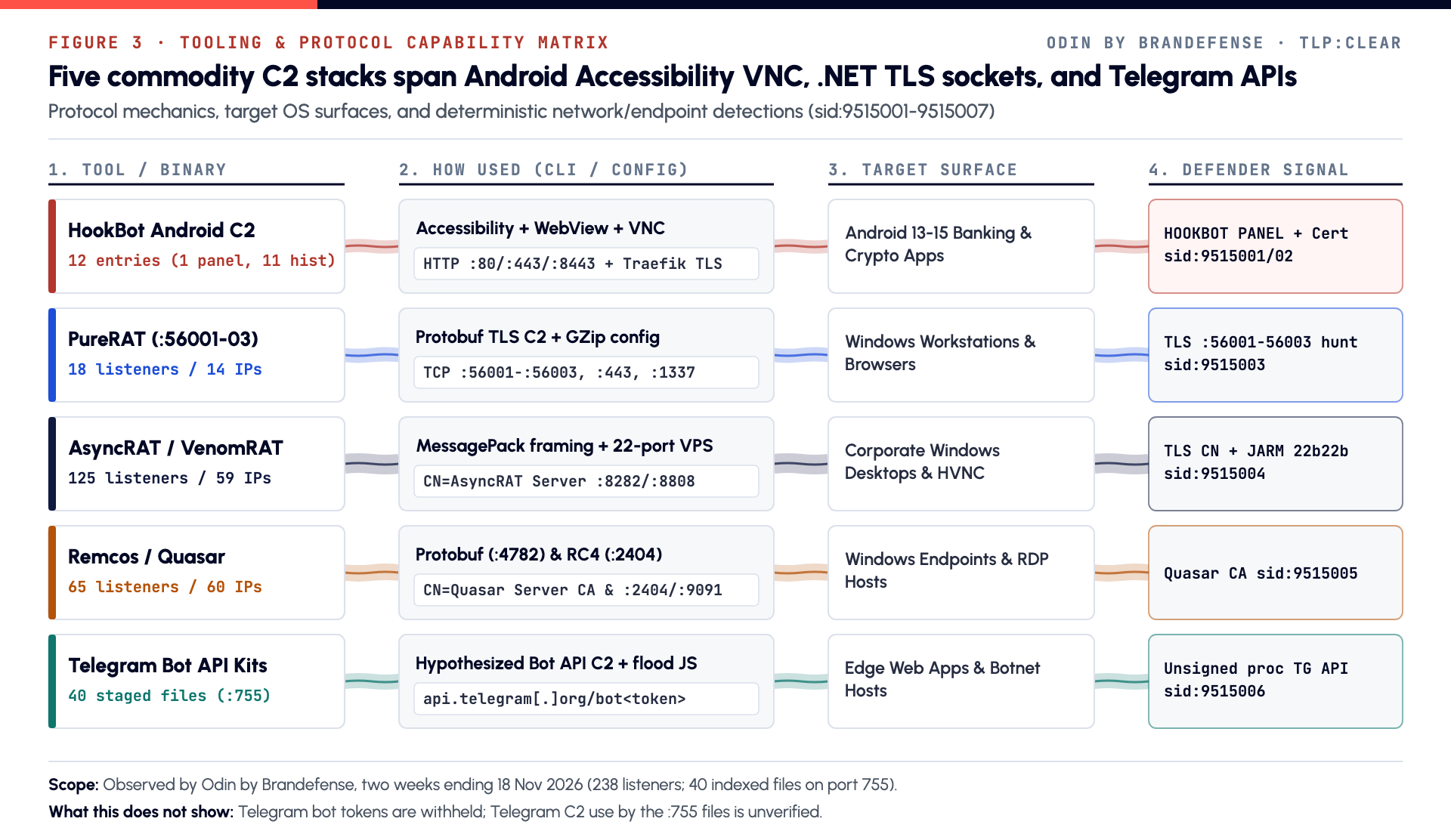
Of all these hosts, only six are block-ready today. Everything else belongs on a watchlist until it is corroborated.
The six are the HookBot panel and five desktop RAT servers: one AsyncRAT, one Quasar, one DCRat and two VenomRAT. Each shows a RAT or panel certificate together with a matching TLS fingerprint or panel marker. A single open port or an old feed tag is not enough, because cheap server addresses change owners often.
Why should banks care about HookBot?
HookBot is an Android banking trojan descended from the leaked Ermac and Hook code. Public research by CSIRT KNF shows what it is built to do. It abuses Android Accessibility to read the screen and approve its own permissions. It draws fake login forms over banking apps. It captures PINs and one-time codes. It streams the screen to the attacker over VNC, so the attacker can tap through a transfer inside the victim's own session.
That last point matters for fraud teams. The transfer comes from the customer's real phone and real session, so device checks alone may not flag it.
We looked at the server side only and saw no victim phones. Of 12 HookBot entries in a threat feed, one stands out. A server in Germany, 152.70.24[.]49, carries a dedicated panel certificate and a matching TLS fingerprint in November 2026. The other 11 entries were first seen in 2025 and show no fresh panel markers. Five of them sit behind a default Traefik proxy certificate. Those addresses may have changed hands, so they go on watchlists, not block lists.
How do RAT operators set up their servers?
Desktop RAT operators rent one cheap server and open many listener ports on it. AsyncRAT averages 2.20 listeners per host across 55 addresses. One Contabo server binds 22 ports. Another hosting network shows the opposite pattern: 16 separate hosts in one subnet, each with a single AsyncRAT listener on port 8282.
PureRAT, a commercial .NET RAT, has a habit defenders can use. Half of its 18 candidate listeners sit on three sequential ports, 56001 to 56003. Its traffic is wrapped in TLS, so the port pattern and the server certificate are the useful signals.
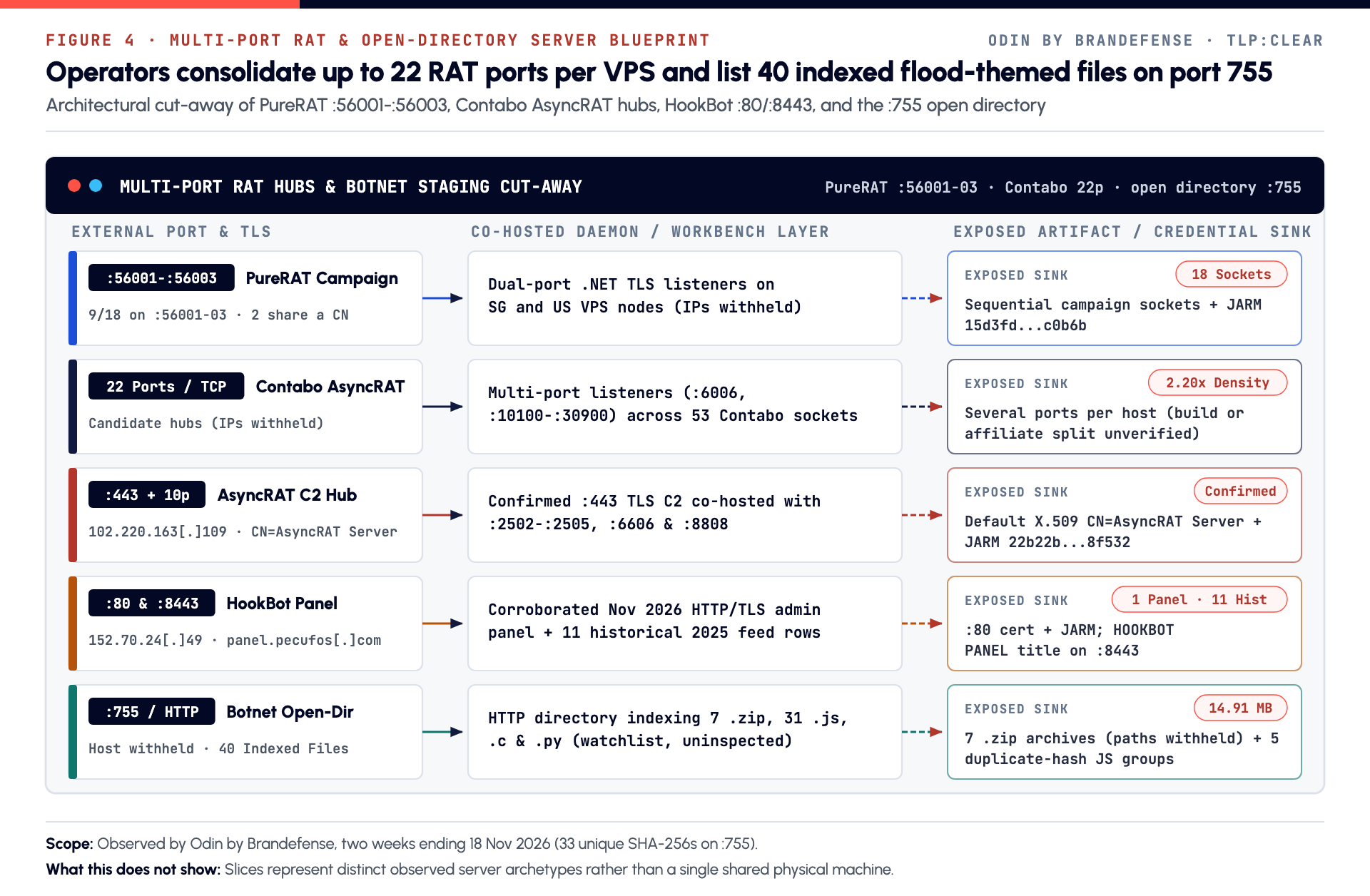
Many RAT servers still use the default certificate their builder creates, such as CN=AsyncRAT Server or CN=Quasar Server CA. Others spoof a software brand or reuse a cloned Windows server image. A cloned image shares a Windows hostname certificate across many hosts, which says nothing about the RAT itself. That is why those hosts stay on watchlists.
What was in the open directory?
The port-755 directory listed 7 ZIP archives, 31 JavaScript files, one C file and one Python file. Their names suggest Telegram-controlled botnets and website flood tools. We recorded names, sizes and hashes, but did not open the files.
The hashes still tell a story. The 39 stored files have only 33 unique hashes, in five groups of identical copies. One script appears twice, once with a "(100$)" price tag in its name. Two others carry AI-themed labels. This looks like resale packaging, but that is an inference from file names only.
Telegram-controlled kits usually poll the Telegram Bot API for commands and send results back the same way. For this directory, that remains a hypothesis. We also cannot rule out that the server is a mirror, a lab or a honeypot. So we withhold its address and file hashes, keep the host on a watchlist, and point defenders to the behavioural detections below.
What to do now
- Block the six confirmed hosts listed in the full report's Indicators tab, including the HookBot panel 152.70.24[.]49. Put older feed entries, candidates and home broadband addresses on watchlists that need a second signal.
- Harden mobile banking. Require Google Play Integrity attestation, and hold transfers while an untrusted Accessibility service or screen-sharing session is active.
- Hunt certificates and port patterns, not single ports. Look for default AsyncRAT and Quasar certificates and TLS handshakes on ports 56001 to 56003. The full report's Detection rules tab has Suricata, Sentinel KQL, Sigma and YARA rules.
- Restrict Telegram Bot API traffic to approved webhook servers and the official client. Alert when scripts or programs in user folders call it.
- Hunt the DDoS and botnet archive names from the open directory in endpoint, mail and web gateway data.
The full report covers the hosting patterns, fingerprints, indicators and rule logic in detail.
What is…?
Short explanations of the tools and families named in this study.
What is HookBot?
HookBot is an Android banking trojan that uses overlay screens and Accessibility abuse to steal credentials and control the device.
More about HookBotTechniqueWhat is JARM?
JARM is an open TLS server fingerprinting method from Salesforce. It hashes how a server answers a set of crafted TLS handshakes.
More about JARMRemote access trojanWhat is AsyncRAT?
AsyncRAT is an open-source .NET remote access trojan widely used in commodity malware campaigns.
More about AsyncRATRemote access trojanWhat is PureRAT?
PureRAT, also tracked as PureHVNC, is a commercial modular .NET remote access trojan with hidden-desktop control.
More about PureRATRemote access trojanWhat is Quasar?
Quasar is an open-source .NET remote access tool for Windows that criminals and some state actors use as a RAT.
More about QuasarRemote access trojanWhat is VenomRAT?
VenomRAT is a commodity remote access trojan descended from the Quasar and AsyncRAT code bases.
More about VenomRATFrequently asked questions
What did we find?
The data splits into three populations. They share no IP address, certificate or known operator. Of all these hosts, only six are block-ready today. Everything else belongs on a watchlist until it is corroborated.
Why should banks care about HookBot?
HookBot is an Android banking trojan descended from the leaked Ermac and Hook code. Public research by CSIRT KNF shows what it is built to do. It abuses Android Accessibility to read the screen and approve its own permissions. It draws fake login forms over banking apps. It captures PINs and one-time codes. It streams the screen to the attacker over VNC, so the attacker can tap through a transfer inside the victim's own session.
How do RAT operators set up their servers?
Desktop RAT operators rent one cheap server and open many listener ports on it. AsyncRAT averages 2.20 listeners per host across 55 addresses. One Contabo server binds 22 ports. Another hosting network shows the opposite pattern: 16 separate hosts in one subnet, each with a single AsyncRAT listener on port 8282.
What was in the open directory?
The port-755 directory listed 7 ZIP archives, 31 JavaScript files, one C file and one Python file. Their names suggest Telegram-controlled botnets and website flood tools. We recorded names, sizes and hashes, but did not open the files.