


Key takeaways
- Odin mapped 718 endpoints on 537 hosts running ten team C2 and emulation frameworks.
- Only 34 endpoints, on 25 addresses, are confirmed C2, all browser shell consoles.
- 239 of 257 Caldera endpoints are vendor banner look-alikes, not attack servers.
- Plugin teamservers such as AdaptixC2 push post-exploitation into memory.
- Block the 18 published confirmed addresses and pair port alerts with memory signals.
In a two-week observation window ending 18 November 2026, Odin by Brandefense mapped 718 internet-facing endpoints on 537 hosts. They run ten team command-and-control (C2) and adversary-emulation frameworks. These tools let several attackers share one server, one set of live shells and one task list. Only 34 of the 718 endpoints are confirmed C2. The rest mix real attack servers with security labs, vendor appliances and mail servers. For defenders, the hard part is knowing which is which.
What are team C2 platforms?
Older attack setups were a single listener in a terminal. Team C2 platforms package everything in a Docker stack instead: reverse shells, payload builders, a task database and a web or desktop console. Several operators log in and work side by side.
The frameworks in this study fall into three working styles.
| Style | Frameworks | Endpoints | Confirmed |
|---|---|---|---|
| Browser shell consoles | SuperShell, ToShellC2, Metasploit, Meterpreter (plus Viper as a front end) | 310 | 34 |
| Plugin teamservers | AdaptixC2, DeimosC2, PyramidC2, TuoniC2 | 146 | 0 |
| Emulation planners | MITRE Caldera, Starkiller | 262 | 0 |
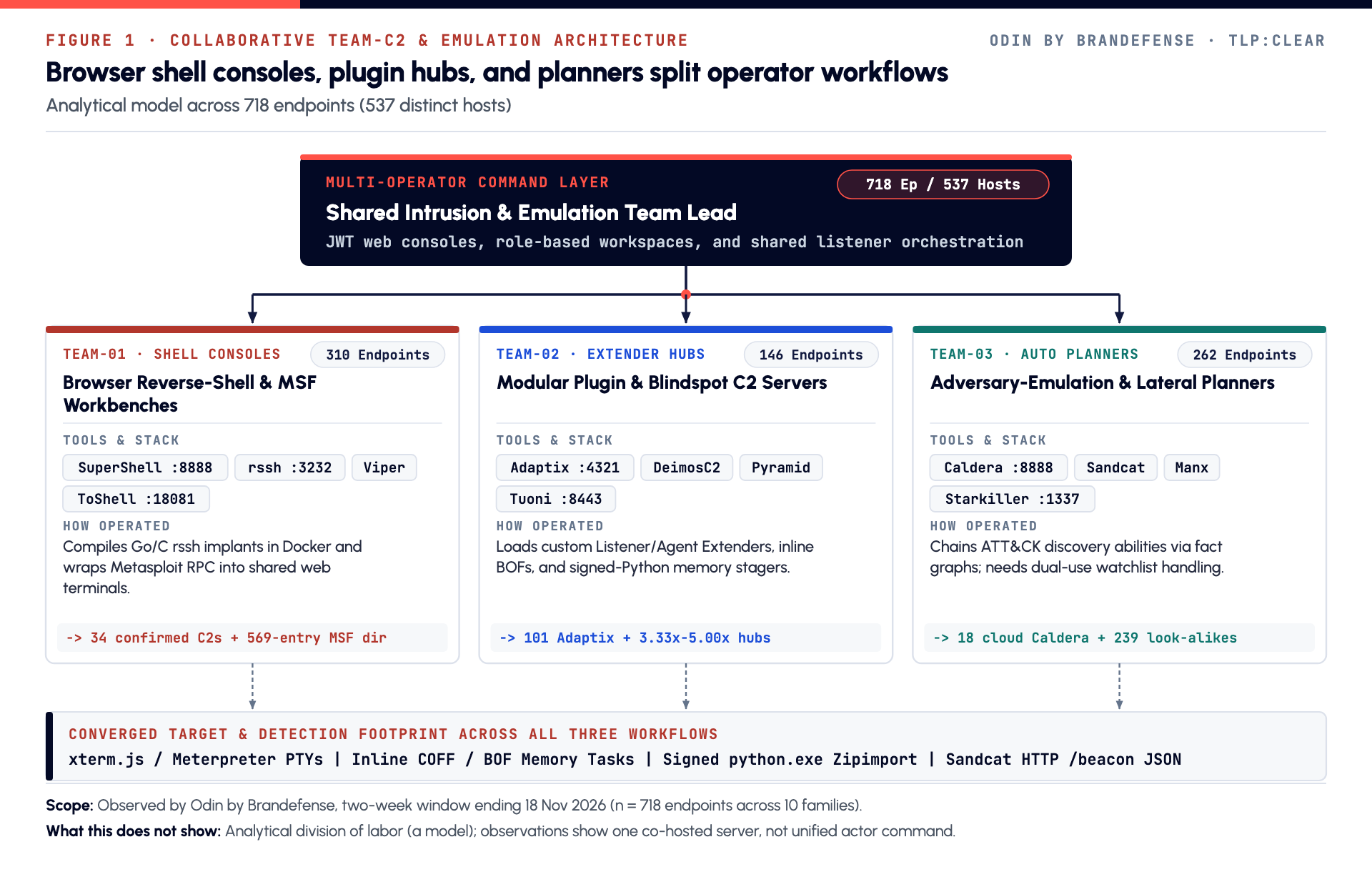
This grouping is an analytical model. It describes how the tools are built, not one actor running them all.
Which servers are confirmed attack infrastructure?
All 34 confirmed endpoints are browser shell consoles. They sit on 25 addresses.
- SuperShell (2). A Docker web portal on port 8888 that builds reverse-SSH implants for Windows and Linux. The implant calls home over TLS, so the target needs no open inbound port.
- ToShellC2 (10). A lightweight web shell panel, mostly on cloud servers in China, Hong Kong and the United States.
- Metasploit (17). Includes a cluster of seven German business-ISP addresses, each listening on ports 443 and 80, and three team listeners on port 3001. The cluster shares one company certificate and could be an authorized tester, so its addresses are withheld.
- Meterpreter (5). Includes one handler hiding on 3389, the Remote Desktop port, so it looks like RDP at a glance.
Viper, a browser workbench for Metasploit, wraps Metasploit's RPC service in a shared web interface.
SuperShell also shows how much of a raw list is noise. Of its 180 endpoints, 169 sit in one Hong Kong hosting cluster. They share TLS fingerprints, but nothing else ties them to SuperShell, so they stay suspected.
Why not block every listener?
Because many of them are not attack servers.
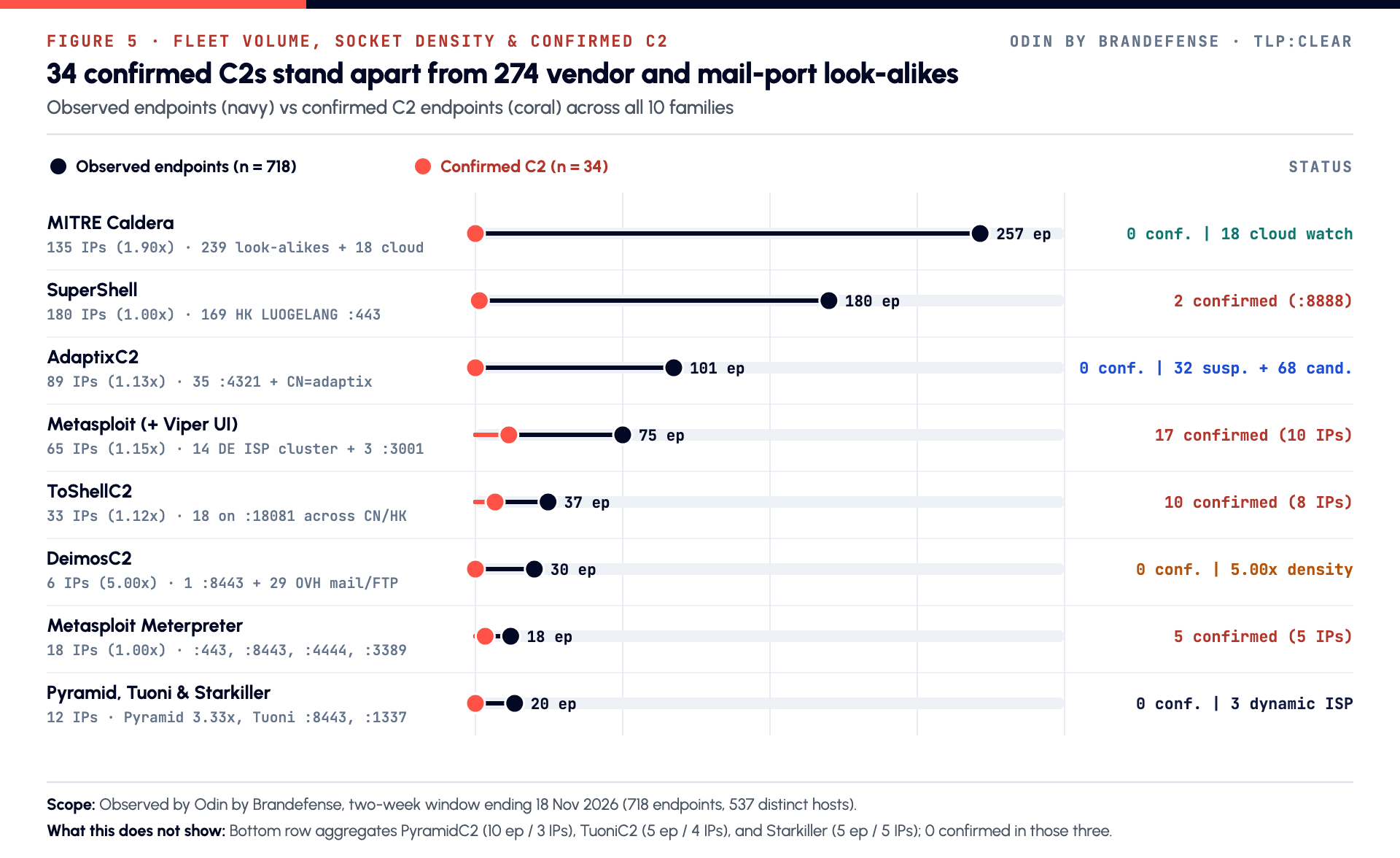
MITRE Caldera is the clearest example. It shows 257 endpoints, but 239 of them are banner look-alikes on a security vendor's own address space. Of the remaining 18 cloud servers, any could be a sanctioned purple-team lab, because purple teams run the same Caldera agents as attackers.
Other look-alikes are just as common. Thirty-five "C2" sockets are ordinary mail and FTP ports on hosting servers. A vulnerability scanner console can look like a Metasploit server. Four endpoints sit on dynamic consumer lines whose addresses change between customers.
Blocking all of these would break legitimate business traffic and teach your team to ignore alerts.
What makes the newer frameworks hard to see?
They move the work into memory.
AdaptixC2 runs on 101 endpoints, 35 of them on its default port 4321. It loads listener and agent plugins on demand and runs small compiled modules, called Beacon Object Files, inside an existing process. Nothing new lands on disk.
PyramidC2 goes further. It uses a signed, trusted Python interpreter to download and load offensive tools straight into memory. Endpoint tools often trust that interpreter.
The practical lesson is that a port alert alone is weak. A port alert followed within minutes by suspicious memory activity on the same workstation is strong.
One more finding stands out. A server in India exposed the full internal Metasploit installation directory to anyone who browsed to it. We cannot tell whether it belongs to a careless lab or an attacker, so its address is withheld. It is a reminder to turn off directory listing on your own staging servers.
How can defenders spot them?
Many operators never change the defaults. SuperShell's reverse-SSH listener presents a self-signed certificate named CN=:3232. AdaptixC2 servers often present CN=adaptix or CN=localhost, and 21 of them share one TLS fingerprint. Caldera agents download themselves from a /file/download path and check in on /beacon. Starkiller operators log in on /api/v2/users/login.
These defaults make good hunting signals, but they are not proof on their own. A certificate or URL match tells you which tool is talking. Your own asset register tells you whether that tool should be there at all.
What to do now
- Block the 18 published confirmed addresses in the full report's Indicators tab, and re-check them after 30 days. The two TLS fingerprints in the full report are for hunting, not blocking.
- Keep dual-use tools on watchlists. Route Caldera, Starkiller and unconfirmed AdaptixC2 listeners to analyst review, and filter out mail ports, vendor banners and dynamic consumer lines before any automatic block.
- Pair network and memory signals. The full report's Detection rules tab has Suricata, Sentinel KQL, Sigma and YARA rules, including a query that joins C2 port traffic with in-memory activity within 10 minutes.
- Restrict signed Python on non-developer workstations and alert when it connects to team C2 ports.
- Register your own emulation servers, put their consoles behind mutual TLS or a VPN, and turn off directory listing.
The full report covers each framework, the infrastructure and the rule logic in detail.
What is…?
Short explanations of the tools and families named in this study.
What is Metasploit?
Metasploit is an open-source penetration testing framework maintained by Rapid7. It bundles exploits, payloads and the Meterpreter post-exploitation agent.
More about MetasploitAdversary emulationWhat is Caldera?
Caldera is MITRE's open-source adversary emulation platform. It plans and runs ATT&CK techniques through agents such as Sandcat.
More about CalderaC2 frameworkWhat is SuperShell?
SuperShell is a web-based C2 platform, usually deployed with Docker, that builds reverse-SSH implants for Windows and Linux and manages them from a browser.
More about SuperShellC2 frameworkWhat is AdaptixC2?
AdaptixC2 is an open-source, extensible post-exploitation and adversary emulation framework with a multi-operator client.
More about AdaptixC2Adversary emulationWhat is Starkiller?
Starkiller is the web interface for the PowerShell Empire post-exploitation framework.
More about StarkillerOffensive frameworkWhat is Viper?
Viper is an open-source browser front end for Metasploit. It adds a multi-operator web interface and a module runner on top of the Metasploit RPC service.
More about ViperFrequently asked questions
What are team C2 platforms?
Older attack setups were a single listener in a terminal. Team C2 platforms package everything in a Docker stack instead: reverse shells, payload builders, a task database and a web or desktop console. Several operators log in and work side by side.
Which servers are confirmed attack infrastructure?
All 34 confirmed endpoints are browser shell consoles. They sit on 25 addresses. Viper, a browser workbench for Metasploit, wraps Metasploit's RPC service in a shared web interface. SuperShell also shows how much of a raw list is noise. Of its 180 endpoints, 169 sit in one Hong Kong hosting cluster. They share TLS fingerprints, but nothing else ties them to SuperShell, so they stay suspected.
Why not block every listener?
Because many of them are not attack servers. MITRE Caldera is the clearest example. It shows 257 endpoints, but 239 of them are banner look-alikes on a security vendor's own address space. Of the remaining 18 cloud servers, any could be a sanctioned purple-team lab, because purple teams run the same Caldera agents as attackers.
What makes the newer frameworks hard to see?
They move the work into memory. AdaptixC2 runs on 101 endpoints, 35 of them on its default port 4321. It loads listener and agent plugins on demand and runs small compiled modules, called Beacon Object Files, inside an existing process. Nothing new lands on disk.
How can defenders spot them?
Many operators never change the defaults. SuperShell's reverse-SSH listener presents a self-signed certificate named CN=:3232. AdaptixC2 servers often present CN=adaptix or CN=localhost, and 21 of them share one TLS fingerprint. Caldera agents download themselves from a /file/download path and check in on /beacon. Starkiller operators log in on /api/v2/users/login.