


North Korea’s state hackers now use AI across much of their work, Microsoft Threat Intelligence reported on 29 October 2026. It rated eight North Korean groups on how far they have taken AI, and three have built it into routine operations. None has handed control to AI: Microsoft says the work stays human-directed. This post separates what Microsoft documented from what it inferred, and lists what defenders should change.
What Does AI Adoption Mean for a Hacking Group?
Here, AI adoption means using generative AI and AI agents inside an attack workflow. Generative AI writes text, code, images or voice from a prompt. Agents go further and run tasks in steps. Microsoft grades North Korean groups on four stages: emerging, expanding, accelerating and operationalized.
The goals have not changed. Microsoft says AI “largely supports existing goals and targeting priorities rather than representing a shift in actor motivations.” Those goals are revenue for the regime, strategic intelligence and, in some cases, disruption. AI makes the same playbook faster and larger.
Microsoft has looked at this before. In March 2026 it called AI a “force multiplier” and said human operators keep control of objectives, targeting and deployment. It already saw Coral Sleet using AI coding tools to build and rework malware parts.
- SleetMicrosoft’s name family for North Korean actors. Other vendors use other names.
- Generative AITools that produce text, code, images or voice from a prompt.
- AI agentsSoftware that plans and runs tasks in several steps with little human input.
- ARTEXAn open-source agentic AI penetration testing framework, as Microsoft describes it.
Which Groups Are at Which Stage?
Microsoft placed eight groups across three stages and left the lowest stage empty. The table restates its own description of each stage.
| Stage | Groups | What the stage means |
|---|---|---|
| Operationalized | Jade Sleet, Coral Sleet, Jasper Sleet | AI is part of routine workflows across their operations. |
| Accelerating | Diamond Sleet, Onyx Sleet, Pearl Sleet, Sapphire Sleet | Rapid adoption across several operational functions. |
| Expanding | Emerald Sleet | AI in selected activities, not yet across wider workflows. |
| Emerging | None assessed | Limited or experimental use. |
Other vendors track these groups under other names. Microsoft’s naming table links Diamond Sleet to Lazarus, Onyx Sleet to Andariel and APT45, Sapphire Sleet to BlueNoroff and Emerald Sleet to Kimsuky. The FBI says TraderTraitor activity “is also tracked as Jade Sleet, UNC4899, and Slow Pisces.”
Our TraderTraitor group profile covers Jade Sleet’s crypto thefts. The Lazarus Group profile and our post on Silent Chollima, also tracked as APT45 and Onyx Sleet, give the longer history.
What Did Microsoft Actually Observe?
The report gives dated cases for most groups. They are its strongest part, because each one names the activity seen.
- Jade Sleet: between 8 and 12 June 2026 it posed as recruiters for a spoofed AI-powered blockchain intelligence company. Targets worked in cybersecurity, AI, blockchain and recruiting. In the same days it ran similar outreach through two more front companies.
- Onyx Sleet: Microsoft found over 100 PDF lures with target-specific details, created in August and September 2026. File metadata showed dozens made at a time within minutes. They fed phishing against South Korean users.
- Coral Sleet: since April 2026 it has run a workflow that trojanizes private GitHub repositories and adds them to its malware chain.
- Sapphire Sleet: Microsoft ties it to the August 2026 Rust software compromise, which began by targeting Rust developers. Its malware compiled .NET code on the fly after exploitation, most likely to evade defenses. Microsoft Defender Antivirus detects the backdoors as ProcmacSteal.
- Diamond Sleet: since August 2026 it has targeted oil and gas again, for the first time since 2023. It also set up fake communications technology firms to approach telecom companies.
- Onyx Sleet and Pearl Sleet: since late October 2026 they have used ARTEX in operations. Microsoft tied the same framework to Storm-0940 in the ConnectWise supply chain case.
Two more cases are described in looser terms. Jasper Sleet, the group behind fake remote IT workers, uses AI to build personas and resumes and to keep several worker identities consistent. Microsoft also saw possible AI-made voice and video from Emerald Sleet, but could not judge its full impact.
Microsoft Threat Intelligence summed up the report on X on the day it was published.
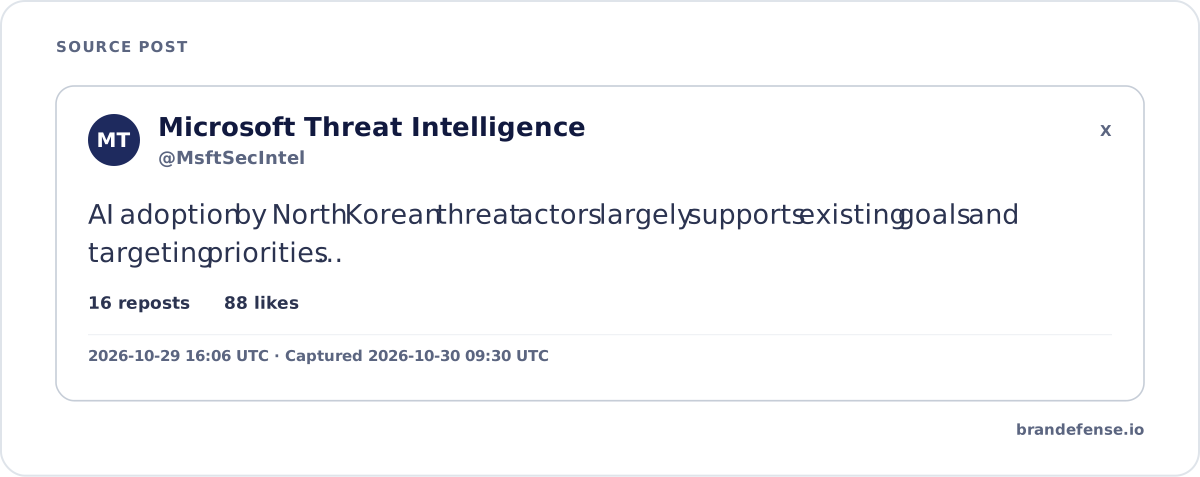
Open the post on X (@MsftSecIntel, Microsoft Threat Intelligence, 29 October 2026, 16:06 UTC).
Where Does the Evidence Stop?
Most findings rest on what AI made possible, not on captured prompts, and Microsoft’s wording shows this. It reads the pace and breadth of Jade Sleet’s outreach as a sign of AI use. It calls the Onyx Sleet lures “highly likely” AI output, based on metadata. Coral Sleet’s repository workflow was “highly likely engineered” with an AI development platform.
The tool claim needs the same care. Microsoft names Cursor as one example of the AI-assisted development platforms that “have likely enabled” Jade Sleet, Coral Sleet, Pearl Sleet and Sapphire Sleet. In our reading, this is not a finding against Cursor itself. It shows attackers use the same coding assistants as developers, to write, convert, debug and hide code.
Two limits matter most. Microsoft says AI-enabled operations “remain human-directed and have not become fully autonomous.” The report also does not tie AI to any named theft. On X, 10 of the 38 posts we captured between 29 and 30 October linked the topic to this week’s large crypto exchange theft. Microsoft’s report does not mention that case.
Our DevOps security analysis drew a similar line on that week’s attacks: AI tools were present, but no source showed AI wrote the exploit. Microsoft’s report is firmer, because it rests on its own telemetry. It still describes faster people, not autonomous machines.
ARTEX is also circulating outside Microsoft’s cases. In Brandefense’s THANOS dark web data, the name came up in 20 Telegram and forum posts between 23 and 30 October, mostly reposted news.
On 30 October a Telegram channel listed the framework’s public repository among tools to download. On the same day a user in an English-language hacking chat asked who was using it. These posts are not verified.
What Should Defenders Change?
The tradecraft is old: social engineering, malware delivery and abuse of legitimate tools. AI raises the volume and polish, so controls that rely on spotting a clumsy lure lose value. Put weight on the checks that hold however good the lure is.
Recruiting Lures Aimed at Your Staff
- Warn engineers, AI and blockchain staff, and your own recruiters that fake recruiter outreach is a main way in, as our WageMole fake recruiter campaign profile also shows. Microsoft names Sapphire Sleet, Jade Sleet and Coral Sleet as users of interview-themed lures.
- Treat a coding test or interview repository from an outside recruiter as untrusted code. Run it only on a disposable machine with no company credentials.
- Check a hiring company’s domain and staff before an interview. Jade Sleet built tailored domains and social media profiles for its fake companies.
Your Own Hiring
Jasper Sleet’s fake workers are an insider threat that arrives through hiring. Microsoft’s vetting advice is concrete:
- Apply more scrutiny to staff from staffing companies, which Microsoft calls the easiest route in.
- Check that phone numbers and profiles are not shared with other accounts.
- Call references by phone or video, not email only.
- See the candidate on camera in several sessions. Treat repeated camera or microphone trouble as a red flag.
Developer Tools, Agents and Repositories
- Review who can read and write private repositories. Alert on new deploy keys, tokens and unusual clone activity, since Coral Sleet’s workflow targets private GitHub repositories.
- Pin and verify package dependencies. The Sapphire Sleet campaign started by targeting Rust developers.
- Give coding assistants and AI agents only the access they need, and review their config files. Our report on how a dropped AGENTS.md file hijacks coding agents shows why.
- Expect machine-speed activity once an attacker holds credentials. Microsoft says Storm-0940 used ARTEX to speed up its sign-in attempts “to machine speed.”
Detection
Microsoft lists detections for each group, including ProcmacSteal for the Rust backdoors and an alert for possible AI tools reconnaissance. It also advises EDR in block mode, network protection and attack surface reduction rules. These controls work whether or not AI wrote the lure.
A good first step this week is two messages. Warn engineering and recruiting about recruiter coding tests, and ask for a list of who holds write access to your private repositories. For tracking these groups’ names, lures and tools over time, see our Cyber Threat Intelligence page.