
A priority intelligence requirement (PIR) is a question your organization needs answered to make one specific security decision, written down with an owner, sources and a review date. This free template gives a five-person team 10 starter PIRs, six of them about threats outside the network, plus an interview sheet, simple metrics and a quarterly review checklist.
- A PIR is a question tied to a decision, with an owner, sources and a review date.
- Ten PIRs are enough for a five-person team. Start there and add only when one is retired.
- Six of the ten starter PIRs look outside the network: leaked credentials, lookalike domains, brand abuse, leak-site mentions, access for sale and supplier exposure.
- Measure decisions supported, not reports sent.
- Review every quarter and retire PIRs that nobody acts on.
Maps to
- NIST SP 800-150 Sections 3.1 to 3.6: goals, internal sources, scope, sharing rules, communities, ongoing support
- NIST CSF 2.0 Identify: ID.RA-02 (receive threat intelligence), ID.RA-03 (record internal and external threats)
- NIST SP 800-61 Rev. 3 Defines cyber threat intelligence for decision-making; lists ID.RA-02 and ID.RA-03 in its CSF 2.0 profile
- ENISA Threat Landscape methodology Background for PIR-08 and PIR-10
- MITRE ATT&CK T1078, T1583.001, T1589.001, T1195, T1566 as tags in the source table
What Is A PIR In Threat Intelligence?
A PIR is a standing question that your threat intelligence work must answer, tied to a decision someone will make. “Which of our staff accounts appear in stolen login sets this week?” is a PIR. “Monitor the dark web” is not, because nobody can say what they will do with the result.
This matches how NIST describes the goal. NIST SP 800-61 Rev. 3 defines cyber threat intelligence as threat information that has been analyzed or enriched to give the context needed for decision-making. NIST SP 800-150 tells organizations to set goals that support business processes and security policy (section 3.1) before they pick sources (section 3.2).
NIST CSF 2.0 names two outcomes in its Identify function that PIRs serve: ID.RA-02 (cyber threat intelligence is received from information sharing forums and sources) and ID.RA-03 (internal and external threats are identified and recorded). A PIR set is a simple way to show you do both on purpose.
If you are new to the topic, start with Threat Intelligence 101 and Threat Intelligence Platforms 101. Strategic, operational and tactical intelligence are three levels of the same job: leaders need strategic answers, the security operations team needs operational and tactical ones. A good PIR set has some of each.
How Do You Write A PIR?
Fill in eight fields for each PIR. Keep each answer to a line or two. The right-hand column shows an example for a PIR about leaked credentials.
| Field | What to write | Example |
|---|---|---|
| 1. Question | One question that can be answered with evidence. | Which staff or admin accounts appear in leaked credential sets or infostealer logs? |
| 2. Why it matters | The harm if you do not know. | A valid login lets an attacker skip most defenses. |
| 3. Decision it supports | The choice the answer changes. | Reset the password, end sessions, require multi-factor authentication, or accept the risk. |
| 4. Consumers | Who receives the answer and acts on it. | IT identity team, security operations. |
| 5. Sources | Where the evidence comes from. | Stolen-credential and infostealer log monitoring, helpdesk reports, breach notices. |
| 6. Collection plan | How and how often you gather it. | Match company domains against new sets each day; review matches each week. |
| 7. Review cadence | When you check that the PIR still earns its place. | Quarterly, and after any major incident. |
| 8. Owner | One named person, by role. | [CTI lead] |
Six steps to write one PIR
- Name the decision. Start from a choice someone really makes, such as patch order, a takedown request or a supplier call.
- Write the question so that a yes, a no or a short list answers it.
- List the people who will act on the answer. If you cannot name one, stop.
- List the sources. Include one source you already have and one you would need to add.
- Write the collection plan: who looks, how often, and where the result goes.
- Set the owner and the review date. Then ask the consumer to confirm in writing.
| Aspect | Weak PIR | Good PIR |
|---|---|---|
| Wording | Monitor the dark web. | Which of our staff accounts appear in stolen login sets this week? |
| Decision | None named. | Reset, block or accept. |
| Owner | The security team. | One named person, by role. |
| Review | When needed. | Every quarter. |
Blank PIR card
Copy this card for each new PIR.
| Field | Fill in |
|---|---|
| PIR id | [PIR-00] |
| Question | [Write one question] |
| Why it matters | [Harm if we do not know] |
| Decision it supports | [Choice the answer changes] |
| Consumers | [Teams or people who act on it] |
| Sources | [Where the evidence comes from] |
| Collection plan | [Who looks, how often, where the result goes] |
| Review cadence | [Weekly, monthly or quarterly] |
| Owner | [Name, role] |
| Last reviewed | [Date] |
What Does A Starter Set Of 10 PIRs Look Like For A Five-Person Team?
Ten PIRs are enough for a team of five. With more than that, the weekly work is unlikely to get done. Replace any row that does not fit your business, but keep a spread: some about threats outside your network, some about your own exposure, some for leaders.
PIR-01 to PIR-06 look outside the company: leaked credentials, lookalike domains, brand abuse, leak-site mentions, supplier exposure and access for sale. The roles in the last column are placeholders. Swap in real names.
| PIR | PIR question | Decision it supports | Consumers | Owner, cadence |
|---|---|---|---|---|
| 01 | Which of our staff, admin or customer accounts appear in leaked credential sets or infostealer logs? | Reset passwords, end sessions, require multi-factor authentication, or accept. | IT identity team, security operations | [CTI lead], weekly |
| 02 | Which new domains copy our brand names or login pages, and are they live? | Block, report for takedown, or warn staff and customers. | Security operations, brand team | [SOC analyst], weekly |
| 03 | Where do fake accounts, ads or apps use our name, logo or executives? | Send takedown requests, brief legal, or warn customers. | Brand, legal, communications | [Brand contact], weekly |
| 04 | Is our company or a subsidiary named on a ransomware or data leak site? | Open an incident, tell legal, start the ransomware playbook. | Security leader, legal, security operations | [CTI lead], daily check |
| 05 | Is a supplier of ours named on a leak site, or has its exposure changed? | Contact the supplier, limit its access, review the contract. | Vendor risk owner, procurement | [Vendor risk owner], weekly |
| 06 | Is anyone offering access to our network, or our data, for sale? | Start an investigation, reset access, hunt for signs of entry. | Security operations, security leader | [CTI lead], weekly |
| 07 | Which actively exploited vulnerabilities affect software we run on internet-facing systems? | Set patch order or add a temporary control. | IT operations, security operations | [SOC analyst], weekly |
| 08 | Which threat actors target our sector and region, and which techniques do they use? | Choose detections to build and tabletop scenarios to run. | Security operations, security leader | [CTI lead], quarterly |
| 09 | Which internet-facing assets do we own that nobody has recorded? | Assign an owner, then fix or retire the asset. | IT operations | [IT admin], monthly |
| 10 | Which outside events could change our risk next quarter, such as new rules, large campaigns or supplier changes? | Adjust budget, priorities and the message to the board. | Security leader, risk | [Security leader], quarterly |
The “why it matters” field is the harm if the decision is made blind. Add a line to each row when you copy it into your own sheet. The sources and collection plan for each row are in the next section.
Where Do External Threat Signals Enter The PIR Cycle?
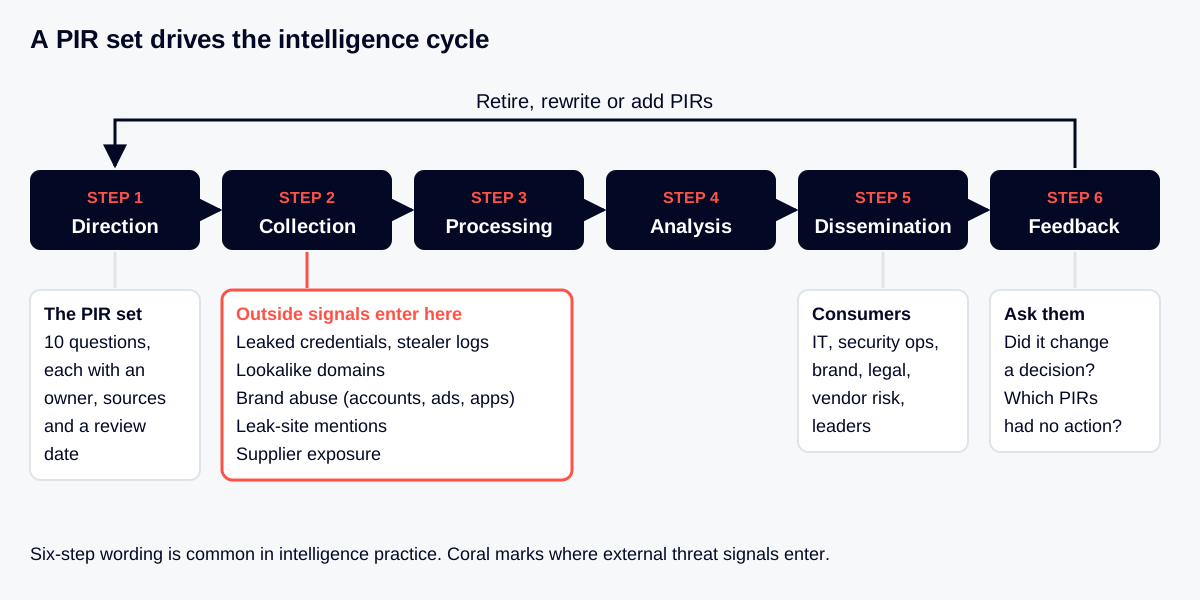
Intelligence work is usually described as a loop: direction, collection, processing, analysis, dissemination and feedback. This six-step wording is common in intelligence practice, not a NIST list. The PIR set is the direction step. Outside signals enter at collection, and your consumers’ feedback decides which PIRs stay.
The table gives a starting source and collection plan for each PIR. Where an ATT&CK technique id helps you tag results, it is listed (ids checked on MITRE ATT&CK). “Not mapped” means we did not map that row. Items in [brackets] are for you to fill in.
| PIR | Sources and collection plan | ATT&CK | Next step if it fires |
|---|---|---|---|
| 01 | Monitor stolen-credential sets and infostealer logs for your company domains. Add helpdesk reports and breach notices. | T1078, T1589.001 | How to respond to leaked credentials, infostealer log exposure |
| 02 | Watch new domain registrations and certificates for your [brand terms]. Check whether each match serves a live page. | T1583.001, T1566 | How to respond to lookalike and phishing domains |
| 03 | Search social networks, ad libraries and app stores for [brand terms] and [executive names]. Add customer reports. | Not mapped | Fake social accounts, fraudulent ads, fake mobile apps |
| 04 | Watch ransomware and data leak sites for [company, domain and subsidiary names]. | Not mapped | Ransomware leak site listings |
| 05 | Watch leak sites for [supplier names and domains]. Check each supplier’s outside-facing exposure on a schedule. | T1195 | Supplier on a leak site, supplier exposure changes |
| 06 | Watch criminal forums and marketplaces for [company, domain and remote-access product names]. | T1078 | Initial access listings, leaked databases |
| 07 | Read national and vendor advisories. Check your own internet-facing systems against your [software list]. | Not mapped | Actively exploited vulnerabilities |
| 08 | Read public threat reports and your [sector sharing group]. Use MITRE ATT&CK group and technique pages to tag what you find. | Group and technique pages | Threat actor landscape |
| 09 | Scan your [IP ranges and domains] from outside. Compare the result with your asset register. | Not mapped | Unknown exposed assets |
| 10 | Read the latest ENISA Threat Landscape report, regulator notices and supplier news. Check the board calendar. | Not mapped | ROI and board report template |
For leaked credentials and lookalike domains, see the use cases Leaked credential monitoring and Phishing and lookalike domains. For suppliers, see Supply chain and vendor risk. When a PIR fires and becomes an incident, move to the incident response plan template; for PIR-04 use the ransomware response playbook; for PIR-05 use the vendor cyber risk questionnaire; for PIR-08 build scenarios with the tabletop exercise injects.
If you are still deciding how to collect, read Feeds, Platform or Managed Service and test any provider with the Threat Intelligence Evaluation Checklist.
How Do You Run Stakeholder Interviews For PIRs?
PIRs come from the people who act on them. Talk to five to eight people for 30 minutes each: the security leader, the security operations lead, IT operations, identity, legal or brand, vendor risk and one business owner. Use the same questions every time and write the answers down.
| Interview detail | Fill in |
|---|---|
| Interviewee and role | [Name, role] |
| Date | [Date] |
| Interviewer | [Name] |
| Decisions this person owns | [List] |
| # | Question to ask | Answer |
|---|---|---|
| 1 | Which decisions do you make each month where outside information would change your choice? | [Answer] |
| 2 | What did you wish you had known earlier in the last year? | [Answer] |
| 3 | Which threats worry you most for our business, and why? | [Answer] |
| 4 | If we told you a login leak, a lookalike domain or a supplier on a leak site, what would you do in the first day? | [Answer] |
| 5 | What format, length and channel do you want updates in? | [Answer] |
| 6 | How often do you want a summary, and how fast must urgent items reach you? | [Answer] |
| 7 | What would you ignore, and what would make you stop reading? | [Answer] |
| 8 | What can you not act on, for lack of authority, tools or budget? | [Answer] |
| 9 | Who else should we talk to? | [Answer] |
| 10 | How will you tell us if the information helped? | [Answer] |
After the interviews
- Turn each decision you heard into a draft PIR using the blank card.
- Merge duplicates. If two people want the same answer, it is one PIR with two consumers.
- Rank the drafts by the harm of deciding blind. Keep the top 10.
- Send the list back. Ask each consumer to confirm the PIRs that affect them.
- File the interview sheets. You will repeat three of them at the quarterly review.
How Does A Five-Person Team Run This Each Week?
Few teams have a full-time analyst. Give each role a small part of the work and keep the rhythm fixed. The hours are yours to set. The roles below are a starting point, not a rule.
| Role | Part of the PIR work | Hours per week |
|---|---|---|
| [CTI lead] | Owns the PIR set, PIR-01, PIR-04, PIR-06 and PIR-08. Writes the weekly summary. | [Hours] |
| [SOC analyst] | Checks PIR-02 and PIR-07. Passes confirmed items to the incident process. | [Hours] |
| [IT admin] | Acts on PIR-01 resets and PIR-09 assets. | [Hours] |
| [Brand or legal contact] | Acts on PIR-03 takedowns and PIR-04 legal steps. | [Hours] |
| [Vendor risk owner] | Owns PIR-05 and talks to suppliers. | [Hours] |
A simple rhythm
- Daily: a 10-minute check of the alerts for PIR-01, PIR-04 and PIR-06.
- Weekly: a 30-minute meeting. For each PIR that fired, record the decision and who acts.
- Monthly: check unknown assets (PIR-09) and the metrics table.
- Quarterly: run the review checklist and send the updated PIR set to consumers.
Collecting these external signals by hand takes time. Teams often use a platform for it. Brandefense Cyber Threat Intelligence and Dark Web Monitoring cover leaked credentials, leak-site mentions and access listings, and Third-Party Risk Management covers supplier exposure.
Which Metrics Show That A PIR Set Works?
Count decisions, not reports. A busy team that sends many updates nobody uses is not doing well. Leave the targets empty until you have one quarter of data. To present the results to leaders, use the ROI Framing and Board Report Template.
| Metric | What it shows | How to count | Target |
|---|---|---|---|
| PIR coverage | How many PIRs are complete and in use. | PIRs with owner, sources, cadence and a consumer, out of 10. | [Set] |
| Decisions supported | Whether the PIRs change anything. | Count of decisions or actions that came from a PIR this quarter, per PIR. | [Set] |
| Time to decision | How fast a signal turns into a choice. | Hours from first sighting to a recorded decision. | [Set] |
| Consumer rating | Whether consumers find it useful. | A 1 to 5 score from each consumer each quarter. | [Set] |
| Stale PIRs | Whether reviews happen. | PIRs not reviewed in their cadence. | [Set] |
| Reports with no action | Noise. | Share of updates after which no one did anything. | [Set] |
| External signals closed | Work done on outside threats. | Accounts reset, lookalike domains reported or blocked, supplier contacts made. | [Set] |
What Should A Quarterly PIR Review Cover?
Set aside two hours once a quarter. Work through the list and tick each line.
- Read each PIR aloud.Is the decision still real? If not, retire it.
- Check each owner.Is the person still in the role and able to do it?
- Count actions per PIR.Rewrite or retire any PIR with no action for two quarters.
- Compare with the business.New products, regions, acquisitions or suppliers may need a new PIR.
- Repeat three interviews.Pick the consumers with the most decisions.
- Test each source.Does it still work? List the gaps.
- Run one end-to-end test per outside PIR.Follow a sample signal to the matching how-to-respond page.
- Read the latest ENISA Threat Landscape report.Update PIR-08 and PIR-10.
- Review the metrics.Set or adjust the targets.
- Publish the new version.Change the version number and date, then send it to consumers.
Keep a short change log at the end of your PIR sheet: version, date, what changed. The ENISA threat landscape work is described in the ENISA Cybersecurity Threat Landscape Methodology, which is useful background for PIR-08 and PIR-10.
Sources: NIST SP 800-150, NIST CSF 2.0, NIST SP 800-61 Rev. 3, ENISA and MITRE ATT&CK.
Questions.
-
What is a threat intelligence program?
It is the set of people, sources and routines that turn outside threat information into decisions. A small one needs a short PIR set, a named owner for each PIR, a weekly rhythm and a quarterly review.
-
How do you build a cyber threat intelligence plan?
Interview the people who make security decisions, turn their decisions into PIRs, pick sources for each PIR, and set owners and a review date. NIST SP 800-150 follows the same order: goals first, then sources.
-
How many PIRs should a small team have?
Ten is a practical start for a team of about five people. If a PIR is not reviewed on time, you have too many.
-
What is the difference between strategic, operational and tactical threat intelligence?
Strategic intelligence helps leaders with long-term risk and budget. Operational intelligence describes actors and campaigns. Tactical intelligence covers technical details such as indicators and techniques.
-
How do you collect threat intelligence for a PIR?
Write a collection plan: which source, who looks, how often and where the result goes. Start with sources you already have, then add the outside sources the PIR needs.
-
Is this template free?
Yes. The Word and Markdown files download with no form, and the full template is on this page. You may reuse it with attribution under CC BY 4.0.
Free download
Take the editable file
No form and no email needed. Edit it, fill in the brackets and keep it with your other plans. Current version: v1.0 · October 2026.
- Download DOCX 47 KB
- Download Markdown 22 KB
How to cite this
Brandefense. Threat Intelligence Requirements (PIR) Template (Free DOCX). v1.0, October 2026. https://brandefense.io/knowledge-hub/guides/threat-intelligence-pir-template/
Change log
- v1.0 · October 2026 First release.
In Our Research
- 1 What “Actionable Intelligence” Actually Means in 2026 April 2026
- 2 The Role of Threat Intelligence in Strengthening Supply Chain Security December 2024
- 3 Incident Response Plan Template (Free DOCX) 101 guide