
security awareness. Tagged Articles.
147 articles tagged security awareness.
 APT Groups
Scattered Spider: An Emerging Cybercriminal Collective
Scattered Spider (UNC3944/Octo Tempest) is one of the most dangerous financially motivated APT groups active in 2025. Known for large-scale social engineering, SIM swapping, Spectre RAT…
APT Groups
Scattered Spider: An Emerging Cybercriminal Collective
Scattered Spider (UNC3944/Octo Tempest) is one of the most dangerous financially motivated APT groups active in 2025. Known for large-scale social engineering, SIM swapping, Spectre RAT…
 Blog
The Economic Dynamics of Data Trade in the Dark Web: Strategic Insights for SOC Analysts and Incident Response Leads
The dark web has evolved into a complex cybercrime economy driven by data trade, pricing dynamics, and service-based crime models. Discover how dark web monitoring breaks…
Blog
The Economic Dynamics of Data Trade in the Dark Web: Strategic Insights for SOC Analysts and Incident Response Leads
The dark web has evolved into a complex cybercrime economy driven by data trade, pricing dynamics, and service-based crime models. Discover how dark web monitoring breaks…
 Blog
APT33/Peach Sandstorm: Threat Forecast and Analysis of a Cloud-Focused Adversary
APT29, also known as Cozy Bear, is one of Russia’s most persistent cyber espionage groups. From SolarWinds to Microsoft, their operations highlight the sophistication of identity-based…
Blog
APT33/Peach Sandstorm: Threat Forecast and Analysis of a Cloud-Focused Adversary
APT29, also known as Cozy Bear, is one of Russia’s most persistent cyber espionage groups. From SolarWinds to Microsoft, their operations highlight the sophistication of identity-based…
 APT Groups
APT33 (Elfin / Refined Kitten): Iran’s Longstanding Cyber-Espionage Arm
APT33, also known as Elfin or Refined Kitten, is Iran’s long-running cyber-espionage group targeting global defense, energy, and aerospace sectors with evolving tactics and tools.
APT Groups
APT33 (Elfin / Refined Kitten): Iran’s Longstanding Cyber-Espionage Arm
APT33, also known as Elfin or Refined Kitten, is Iran’s long-running cyber-espionage group targeting global defense, energy, and aerospace sectors with evolving tactics and tools.
 APT Groups
Hazy Tiger: An Emerging Espionage Threat in South Asia
Hazy Tiger is a South Asia-linked APT group active since 2013, targeting government, defense, and energy sectors through sophisticated espionage campaigns involving phishing, malware, and custom…
APT Groups
Hazy Tiger: An Emerging Espionage Threat in South Asia
Hazy Tiger is a South Asia-linked APT group active since 2013, targeting government, defense, and energy sectors through sophisticated espionage campaigns involving phishing, malware, and custom…
 APT Groups
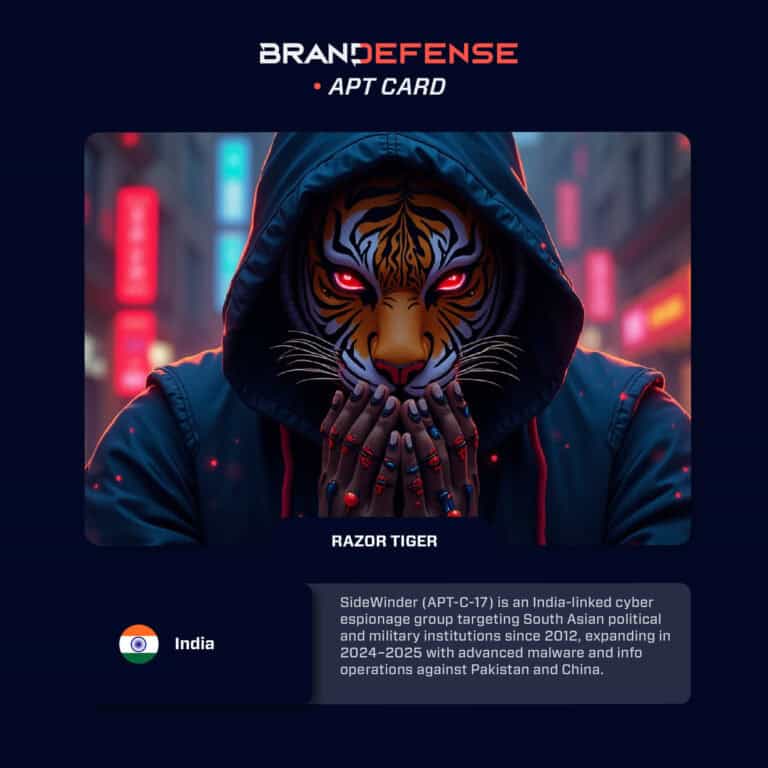
RAZOR TIGER: The Persistent South Asian Espionage Threat
Razor Tiger (APT-C-17), also known as SideWinder, is a long-standing India-linked APT group active since 2012. Its evolving espionage campaigns now target South Asian governments, defense,…
APT Groups
RAZOR TIGER: The Persistent South Asian Espionage Threat
Razor Tiger (APT-C-17), also known as SideWinder, is a long-standing India-linked APT group active since 2012. Its evolving espionage campaigns now target South Asian governments, defense,…
 APT Groups
UNC4841 / SLIME57: China-Linked Espionage Threat Expanding Global Operations
UNC4841, also known as SLIME57, is a China-linked APT group active since 2021, conducting cyber-espionage across government, defense, and tech sectors. Exploiting zero-day vulnerabilities and maintaining…
APT Groups
UNC4841 / SLIME57: China-Linked Espionage Threat Expanding Global Operations
UNC4841, also known as SLIME57, is a China-linked APT group active since 2021, conducting cyber-espionage across government, defense, and tech sectors. Exploiting zero-day vulnerabilities and maintaining…
 APT Groups
Ghostwriter: Hybrid Influence and Espionage Operations in Eastern Europe
Ghostwriter, a Belarus/Russia-linked APT active since 2016, executes hybrid campaigns combining espionage, phishing, and disinformation against NATO and EU entities. Learn how these operations evolved into…
APT Groups
Ghostwriter: Hybrid Influence and Espionage Operations in Eastern Europe
Ghostwriter, a Belarus/Russia-linked APT active since 2016, executes hybrid campaigns combining espionage, phishing, and disinformation against NATO and EU entities. Learn how these operations evolved into…
 APT Groups
GhostEmperor: Advanced China-Linked Espionage Campaigns
GhostEmperor is a China-linked APT active since 2019, leveraging stealthy rootkits like Demodex to conduct espionage across Asia, the Middle East, and Africa. Known for its…
APT Groups
GhostEmperor: Advanced China-Linked Espionage Campaigns
GhostEmperor is a China-linked APT active since 2019, leveraging stealthy rootkits like Demodex to conduct espionage across Asia, the Middle East, and Africa. Known for its…
 APT Groups
Earth Estries – Threat Actor Sheet
Earth Estries is a China-linked APT group active since the early 2020s, known for espionage campaigns targeting global governments, research institutions, and critical infrastructure. By 2025,…
APT Groups
Earth Estries – Threat Actor Sheet
Earth Estries is a China-linked APT group active since the early 2020s, known for espionage campaigns targeting global governments, research institutions, and critical infrastructure. By 2025,…
 Blog
APT32 Targeting NGOs: A Perspective
APT32 (OceanLotus), a Vietnam-linked APT group, has intensified its cyber-espionage operations in 2025, targeting NGOs and cybersecurity professionals through sophisticated supply-chain tactics, stealthy persistence methods, and…
Blog
APT32 Targeting NGOs: A Perspective
APT32 (OceanLotus), a Vietnam-linked APT group, has intensified its cyber-espionage operations in 2025, targeting NGOs and cybersecurity professionals through sophisticated supply-chain tactics, stealthy persistence methods, and…
 Blog
Telegram Leaks and Dark Channels: How Criminals Use Telegram
How criminals share stolen data through Telegram channels and bots, what monitored groups show, and what to do about it.
Blog
Telegram Leaks and Dark Channels: How Criminals Use Telegram
How criminals share stolen data through Telegram channels and bots, what monitored groups show, and what to do about it.
About The Blog.
Last updated June 9, 2026-
Articles on ransomware, APT groups, the dark web, digital risk protection, fraud, sector analysis and VIP security, written for security teams.
-
New articles are added several times a month. The newest come first, and every article shows its publish date.
-
Use the topic chips above the list to open one topic, or type a word in the search box. Each topic has its own page.
-
Articles draw on public sources such as CISA advisories, MITRE ATT&CK and ENISA reports. Sources are listed at the end of an article when it cites them.
-
The site feed at brandefense.io/feed/ lists new posts. The email sign-up box is on the All Resources and Reports pages.
-
Brandefense is an AI-driven threat intelligence company. Its platform covers cyber threat intelligence, digital risk protection and external attack surface management. You can request a demo on your own domain from the Request A Demo page.
-
The blog page shows 470 articles. You can open all of them or pick one topic, such as APT Groups, Dark Web, Ransomware or Fraud. Each article shows its publish date.
-
The blog describes its articles as explained by the analysts who track threats. They cover threat actors, dark web activity, ransomware and digital risk. The newest articles appear first.
-
Yes. APT Groups is one of the topic chips above the list, and it opens only the articles on that topic. The Knowledge Hub also holds profiles of threat groups.
-
The surface web is the part of the internet that search engines list. The deep web is content that search engines do not list, such as pages behind a login. The dark web needs special software to reach. The blog has an article that explains the three layers in plain words.